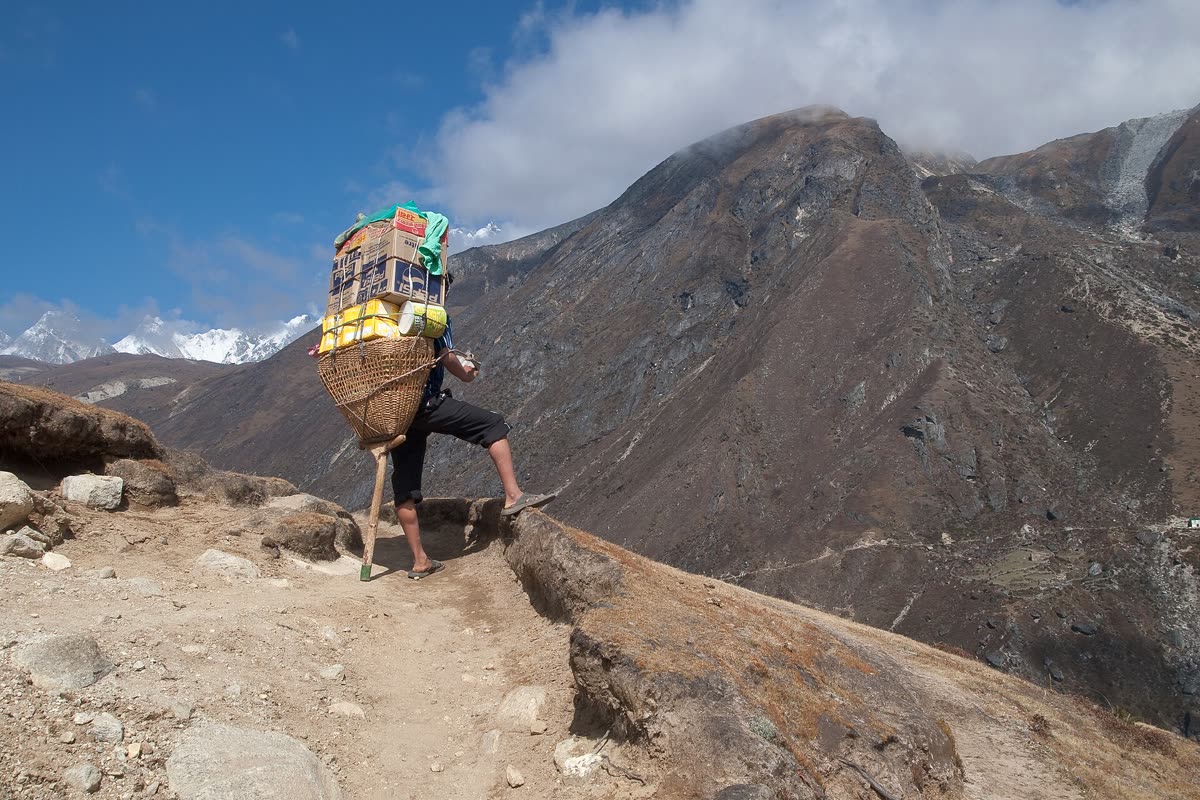
Porter welfare
Portering is hard, skilled, dangerous work, and the industry has a poor record on it. Porters have died on trails that trekkers walked in comfort, usually because they were carrying too much, sleeping badly and wearing the wrong clothes.
Our standing commitments:
- Weight limits, enforced. One porter per two trekkers, up to around 20 kg total. If your kit exceeds the allowance we quote an extra porter — we don't quietly add it to somebody's load.
- Insurance for every porter and guide, including helicopter evacuation, at the same level we expect you to hold.
- Proper equipment — boots, jacket, gloves, sunglasses and sleeping bag, provided by us and not deducted from wages.
- Indoor lodging and three meals every night on the trail, in the same villages we stay in.
- Altitude monitoring for staff too. A sick porter goes down with a guide, on our cost, without argument.
Weight limit, insurance cover, who provides equipment, where porters sleep, and what happens when one falls ill. A company that can answer instantly is one that has thought about it.
Waste and water
Every plastic bottle carried above Lukla stays in the Khumbu — there is no waste collection, and burning or burying is the usual fate. A single trekker drinking bottled water for a fortnight leaves behind roughly thirty bottles.
We ask every trekker to bring a bottle and treatment — tablets, drops or a SteriPen. Our guides carry spares and refill from safe sources. It costs less than buying water and it's the single easiest thing any visitor can do.
We also pack out our own group waste, including batteries and anything foil-wrapped, and take part in the clean-up collections run in Namche and Gorak Shep during the main seasons.
Firewood and lodges
Above the treeline, heating means burning either yak dung or wood carried up from lower forests. Trekker demand for hot showers and warm dining rooms has a direct effect on both.
We favour lodges using solar water heating and efficient stoves, we don't promise hot showers at the highest camps, and we brief groups honestly: at 5,000 m, a warm sleeping bag is a better plan than a hot shower.
Where the money goes
Trekking only benefits mountain communities if the spending actually reaches them. We use locally owned teahouses rather than operator-owned lodges, employ guides from the regions they work in, and buy food locally where the supply chain allows.
Restricted-area permits for Manaslu and Upper Mustang carry fees intended for local conservation and development. We'd rather those regions stay expensive and protected than become cheap and crowded.
Being a decent guest
The Khumbu and Mustang are living Buddhist cultures, not scenery. Small things matter: walk clockwise around stupas and mani stones, ask before photographing people, dress modestly in villages and monasteries, remove boots where asked, and don't touch anyone's head or point your feet at an altar.
Your guide will tell you the local etiquette for wherever you are. The general principle is the one that travels everywhere — behave like you're in someone's home, because you are.